





It’s a torrid moment in American history, one characterized by precisely the kind of moral torpor to which Ben Shahn’s art and what he called his “righteous indignation” were most closely attuned. So it seems like a good moment to look specifically at Shahn’s posters, seven of which are in the Poster House collection. Most of the posters I will talk about here were on display in the Jewish Museum’s comprehensive exhibition, Ben Shahn, On Nonconformity (which Poster House members got a special tour of last August).
Shahn’s series of 23 gouache paintings titled The Passion of Sacco and Vanzetti (1931–32), focusing on what many believed was the wrongful execution of two Italian immigrants in Boston, are among the earliest of the images he would produce over the next decades addressing injustice and inequality. But his career really took off when he found work with government relief agencies during the 1930s, promoting the programs and agenda of Franklin D. Roosevelt’s New Deal.
Years of Dust (1936), by Ben Shahn
Image Source: MoMA
In this capacity he worked as a graphic designer and as a muralist (for the Bronx Central Post Office and the New Jersey Homesteads, for example), and also as a photographer for the Resettlement Administration (RA), documenting the rural devastation caused by the farm crisis and the Dust Bowl. This was part of an extensive federally funded photographic record that also included the work of established photographers like Dorothea Lange as well as Walker Evans, with whom Shahn had usefully shared a studio in New York. In posters for the RA like Years of Dust from 1936, he drew on subjects from his own photographs, part of an archive of images that he would continue to use in his paintings and graphic designs.
We French Workers Warn You/Defeat Means Slavery Starvation Death (1942), by Ben Shahn
Image Source: Poster House Permanent Collection
Shahn made We French Workers Warn You/Defeat Means Slavery Starvation Death and This Is Nazi Brutality after he joined the Graphics Division of the Office of War Information (OWI) in the summer of 1942, one of the innumerable artists brought in to produce propaganda material to encourage public support for the Allied cause. And one might reasonably assume that an artist with an incorruptible commitment to justice would have done well with such an assignment. But while he worked on a number of poster campaigns and pamphlets for the agency, sometimes in collaboration with other artists, by the time he left a year or so later, these two posters were the only ones that had actually been circulated by the OWI.
We French Workers Warn You/Defeat Means Slavery Starvation Death was closely based on a painting he made the same year (now in the Museo Nacional Thyssen-Bornemisza in Madrid). But the robust outlines of the composition also point to Shahn’s early training as a lithographer in Lower Manhattan, an experience that would inform much of his later work. “I found that this chiseled sort of line had become a necessity, a sort of temperamental fixture, so that even when I drew with a brush the line retained that style,” Shahn wrote in his 1963 monograph Love and Joy About Letters.
Here, French workers warn their American counterparts and allies about the monstrous consequences of defeat as they raise their hands (to emphasize the manual labor that they perform) in surrender and/or protest. Behind them is the official decree issued by the collaborationist Vichy government on September 4, 1942, that subjected French workers to compulsory labor in the German war industry. But Shahn’s poster also reflects the dedication to union and leftist causes that defined his entire life and career. And like the photographs, paintings, posters, and murals he made under the New Deal, such images reflect a new political concern about the fate (and expanding power) of the American worker during the Depression, evidenced, not least, by the passing of the National Labor Relations Act in 1935 in response to workers uprisings and strikes.
These political developments were mirrored in countless artistic representations of the struggles of the unemployed, well represented by Clare Leighton’s 1932 wood engraving Bread Line, New York and the famous film sequence “My Forgotten Man” from Gold Diggers of 1933. (Make sure to watch the spectacular Busby Berkeley numbers in that one too, if you are so inclined.)
This Is Nazi Brutality (1942), by Ben Shahn
Image Source: Poster House Permanent Collection
This Is Nazi Brutality was commissioned from Shahn by Francis Edwin Brennan, chief of the Graphics Division of the OWI; like We French Workers Warn You, it was officially intended to remind Americans of the urgent need to continue the fight. And it similarly suggests why Shahn’s artistic methods and political radicalism were ultimately never going to wash with the corporate advertising men brought in to advise the OWI after 1943 and their mission to find, as Brennan described it at the time of his resignation in April of that year, “the lowest common denominator that will speak to all.”
While American newspapers were reporting on the atrocities in Europe, the OWI was still deliberating about how to represent them to the American public. Shahn’s poster showing a hooded, handcuffed figure standing against a brick wall, his fists clenched in fear (and perhaps defiance), was his way of illustrating what the Washington Post described as “the most savage single act of repression in the history of Germany occupation of continental Europe.” The figure stands in for the men of the Czech mining village of Lidice. All of them, as the shameless ticker-tape message from Berlin Radio in the foreground of the image states, were shot, and the women and children deported to concentration camps before the village itself was reduced to rubble. This was enacted on the night of June 9, 1942, in retaliation for the murder of Reinhard Heydrich (“the Butcher of Prague”) by British-trained Free Czech agents. While there is no sign of blood or direct violence in Shahn’s composition, it’s deeply unsettling; the condition and emotions of the man under the sack are left to the viewer’s imagination. It’s also not immediately readable since the (notably modernist) layering of typography and “found text” requires close examination.
Shahn evidently could not have been less interested in the formulaic, if hugely successful, commercial idioms of the OWI as they evolved under the ad men, the square-jawed heroes squinting bravely into the future like those in Stanley Ekman’s United/All America Is on the March! or the housewife cheerfully muddling through in favor of the war effort in Valentino Sarra’s I’ll Carry Mine Too!
Left: United/All America Is on the March! (c. 1942), by Stanley Ekman
Image Source: Poster House Permanent Collection
Right: I’ll Carry Mine Too! (1943), by Valentino Sarra
Image Source: Poster House Permanent Collection
As Christof Decker observed in an article for American Art, “Shahn’s work was too complex to be quickly and easily digested and too ambiguous in its messaging.” In these two posters, he adheres to the official brief, urging the public to fight European fascism with superior American values; at the same time, he confronts the viewer with the struggle for justice and equality at home and with imagery that is disturbing, ugly, and not immediately decipherable. It might explain why the OWI rejected many of Shahn’s designs. Among them were a series on The Nature of the Enemy from c. 1942, based on five central themes—suppression, starvation, slavery, torture, and murder—featuring brutal images under the tagline “The Enemy Method”—and Our Manpower (with Muriel Rukeyser, c. 1943) showing a Black and a white welder standing together above the message “1/5 of our strength must not be lost through discrimination” (presumably because it highlighted racial conflict in the workplace).
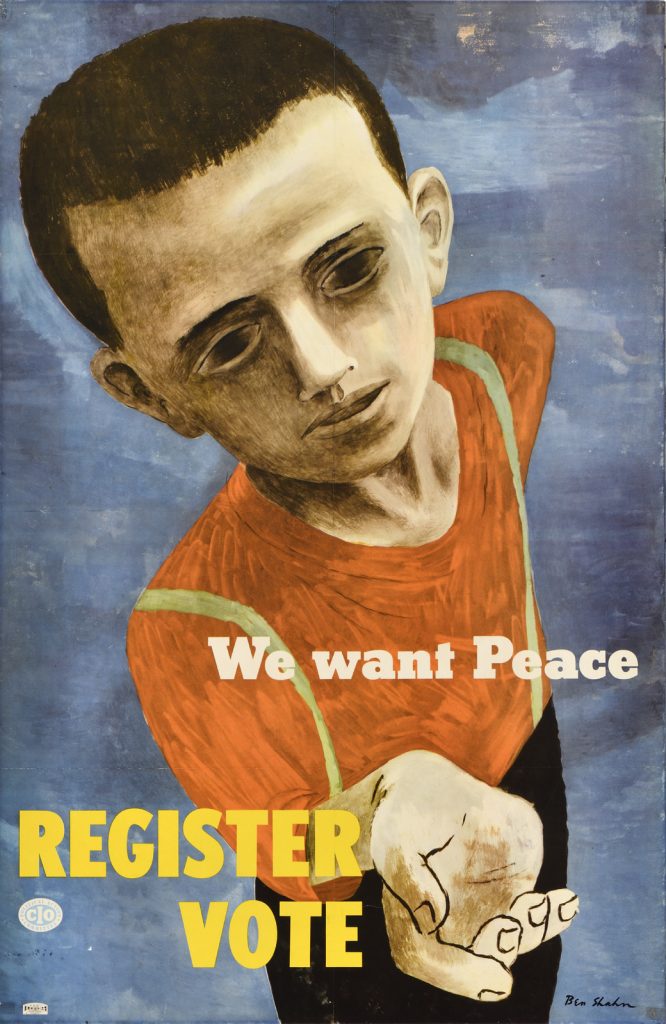
We Want Peace/Register Vote (1946), by Ben Shahn
Image Source: Poster House Permanent Collection
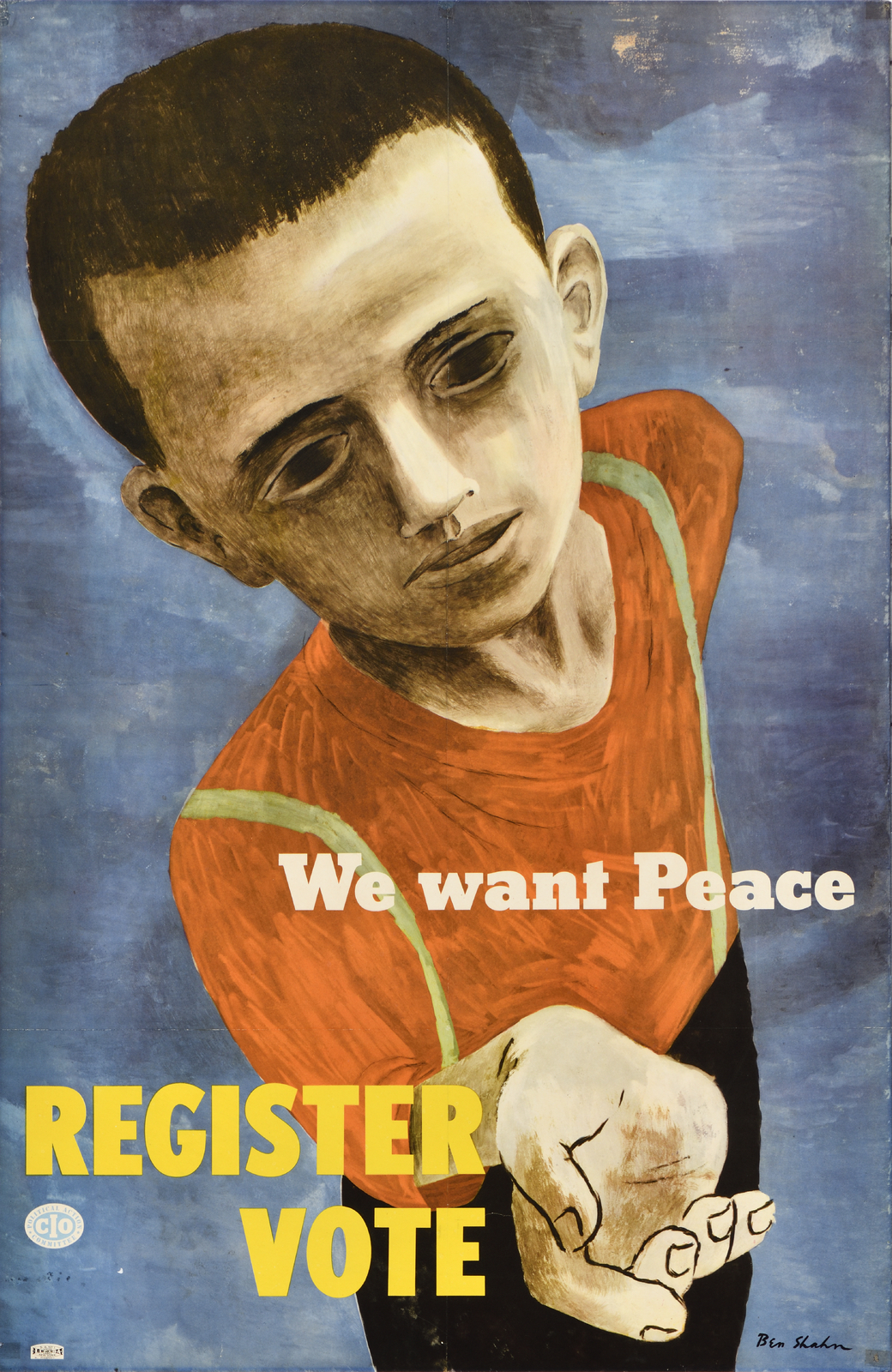
Shahn produced this poster, We Want Peace, Register, Vote (1946), while he was serving as chief artist and director of the Graphic Arts Division of the Congress of Industrial Organizations-Political Action Committee (CIO-PAC, an organization with a distinctly Stalinist-sounding name), between 1944 and 1946. It was one of a series he designed for the committee in support of pro-labor and liberal Democratic candidates. The emaciated boy here, hand outstretched, was actually based on a painting and poster design Shahn had made during the war, as well on his photographs of coal miners’ children in West Virginia from the 1930s. He redeploys the images in this poster to evoke the tragic victims of the recent war and the anxiety of a workforce operating under Harry S. Truman, a president much less supportive of labor than Roosevelt had been.
A Good Man Is Hard to Find (1948), by Ben Shahn
Image Source: Poster House Permanent Collection
A Good Man Is Hard to Find from 1948 was Shahn’s effort to support Henry Wallace of the rather transitory, very left-wing Progressive Party against Truman, then the Democratic nominee, and his Republican opponent, Thomas E. Dewey. Here, he brutally caricatures the two men with their fake smiles, as Truman plays the piano, all folksy in shirtsleeves, and Dewey lounges on top of it in evening clothes. There’s something inherently sleazy about these characters, suggests Shahn, a message reinforced by the titles of the songsheets at the piano: “Little White Lies” and “A Good Man Is Hard to Find.”
Stop H Bomb Tests! (1960), by Ben Shahn
Image Source: Poster House Permanent Collection
After the war, Shahn’s artistic reputation was vastly enhanced by a mid-career retrospective at the Museum of Modern Art in 1947 and the fact that the museum chose him in 1954, with Willem de Kooning, to represent American painting at the Venice Biennale. But the immediate future would belong to De Kooning and other contemporaries like Jackson Pollock, Mark Rothko, and Robert Motherwell; as curators and critics championed abstract expressionism and non-objective art, Shahn’s figurations began to appear decidedly old hat.
His dedication to social and political causes, however, remained as bold as ever. He produced the huge poster Stop H Bomb Tests from 1960 (recently featured in Poster House’s exhibition Fallout: Atoms for War & Peace) as one of many works made in opposition to postwar nuclear proliferation. Shahn believed that the arts must ultimately steer science and technology, realms he saw as entirely devoid of moral, spiritual, and philosophical content. In a 1950 article titled “Just What is Realism in Art?,” he had written, “There is so much about man and his environment still to be learned and crystallized in art. One could hope that there might arise out of such an effort a real resurgence of Humanism. And in this era of almost total mechanization and H-Bombs, I, myself, feel that this objective is of first importance.” This poster for the National Committee for a Sane Nuclear Policy also signifies a departure from the figurative realism that defined much of his graphic work; the flattened, semi-abstract form of a black bull with a cartoonish face represents an atomic weapon barely contained by the amorphous blue shape and bold red lettering that surround it.
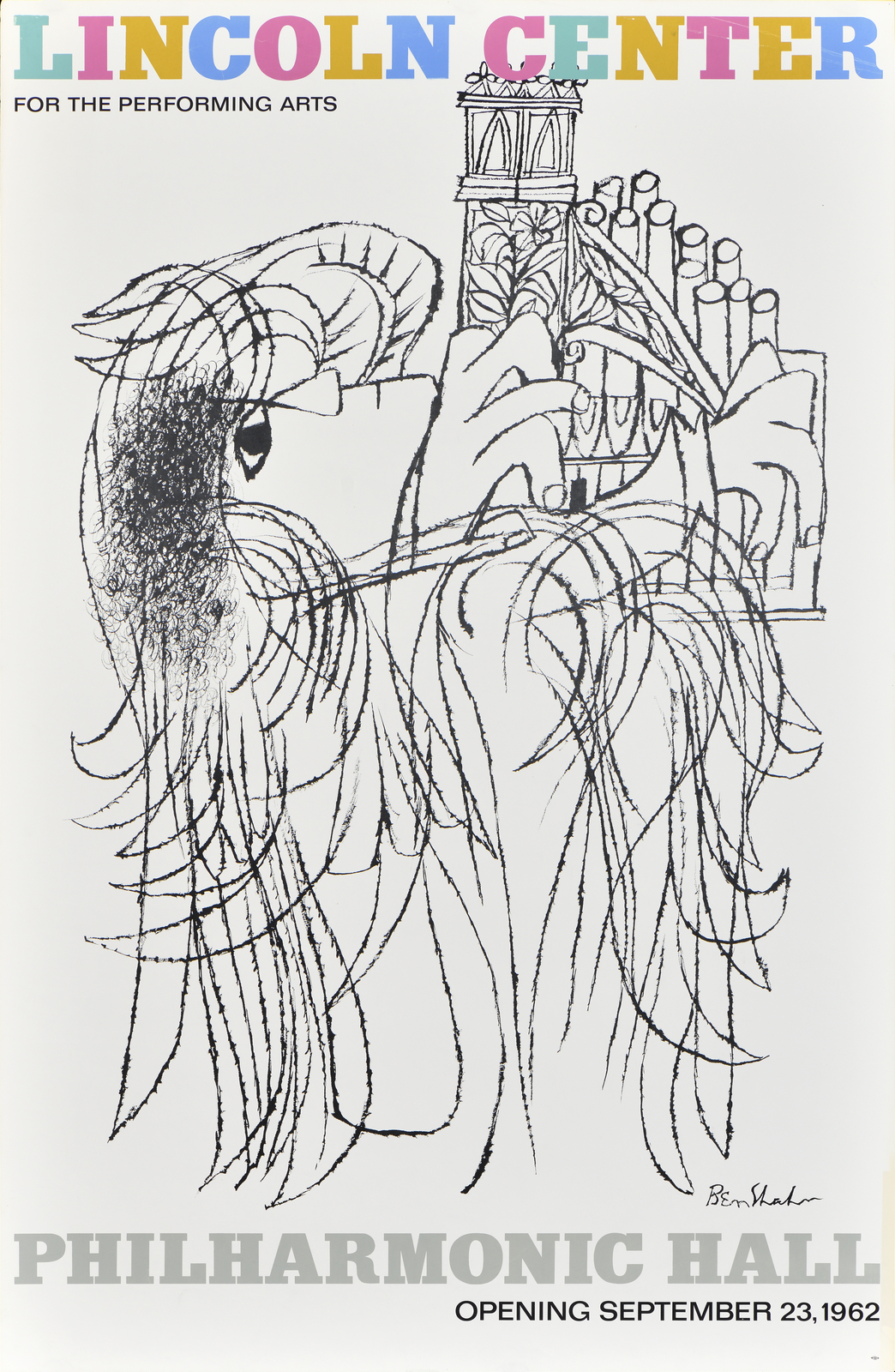
Left: Lincoln Center/Philharmonic Hall (1962), by Ben Shahn
Image Source: Poster House Permanent Collection
Right: McCarthy/Peace (1968), by Ben Shahn
Image Source: Poster House Permanent Collection
The two posters in the collection from late in Shahn’s career are slighter and more lyrical, reflecting both his love of music and his unfailing dedication to social justice. In the 1962 poster announcing the opening of Lincoln Center’s Philharmonic Hall, he describes in swirling lines an angel playing a medieval organ; and in his 1968 composition McCarthy/Peace—made for the anti-Vietnam campaign of Senator Eugene McCarthy as he challenged President Lyndon B. Johnson for the Democratic presidential nomination—he shows a dove (perhaps a nod to Picasso), wearing the stripes of the American flag. Together, as much as his more radical images, they assert Shahn’s understanding of art as a means of communicating moral and ethical values, his belief that, as he proclaimed in a 1951 speech: “It is the mission of art to remind man from time to time that he is human, and the time is ripe, just now, today, for such a reminder.”
Catherine Bindman is an editor and art critic specializing in prints and drawings.