


New York’s fight against the AIDS epidemic reveals the connections between the many diverse communities that made up the creative constellation of the city and their roles in activism, organizing, and fundraising for the cause. In this blog post, fashion historian Natalie Nudell interviewed two important figures in the American fashion industry who both participated in the fight and witnessed the significant impact AIDS had on the city’s creative communities and on society more broadly. She shared with them a selection of posters and ephemera featured in Love & Fury: New York’s Fight Against AIDS and asked them to share their memories and experiences, and talk about how these images resonated with them at the time.
Stan Herman, the legendary fashion designer for Mr. Mort and president of the Council of Fashion Designers of America (CFDA) from 1991 to 2006, was involved with the movement from its onset. As a board member of the East End Gay Organization, he organized A Gala Night for Singing, a benefit for AIDS, in 1985. The event’s poster was designed by Paul Davis and is featured in Love & Fury: New York’s Fight Against AIDS.
Steven Kolb is the CEO of the CFDA and began his career in non-profit fundraising in New York City in 1989 at the Design Industries Foundation Fight Against AIDS (DIFFA). The organization was one of the first to galvanize an entire industry for the cause and its Safer Sex campaigns and Love Ball events with nightlife maven Susanne Bartsch set the tone for an entire generation of community organizing.
Angels in America (1993) by Milton Glaser
Poster House Permanent Collection
Stan Herman: Well, this is one of the most beautiful posters I’ve ever seen. I remember it vividly because Angels in America was the clutch of our lives at that time. It really put everything out there in a way that we hadn’t had it before. And Tony Kushner—I knew him at that moment. So, it was a very personal poster for me…Milton [Glaser] was a very good friend of mine. And when any poster was needed, he would be there for you. He just died five years ago. I forgot that was a Milton poster. God, you’re jogging my memory. But Tony Kushner, Milton Glaser, these are monster people in the movement. We didn’t have enough of them.
Natalie Nudell: How impactful do you think Angels in America was to the movement generally?
SH: I think I saw it most because I lived with a writer and Tony Kushner was an important writer to him. I think that everything led to the same road, the same road that the play, the artist, the way he approached it. I forgot how great this is. I could cry just looking at it
NN: Do you feel like this poster is emblematic of Milton Glaser’s style?
SH: No. No, I don’t…That’s the thing. I know he had a big studio, you know, and he had a lot of people working for him. I don’t know where that came from, where the essence of this came from, but it doesn’t look like Milton first off. Oh, but it hit the nail on the head. My god, I’d love to have that.
A Gala Night for Singing (1985) by Paul Davis
Poster House Permanent Collection
SH: This is my poster. I mean, I didn’t design it but I sat down with Paul, who was a very good friend of mine, and his wife, and I remember what I said to him quite vividly. I said, “It’s extremely important that whatever you do…the figure doesn’t have any sex. It can be either male or female but it should look androgynous. It should look like either one or both at the same time.” And when I saw the image, I was freaked. I thought, boy, he hit it really on the head. I have the number one signature on my wall here [in East Hampton]. I have one in New York in my apartment, and I’m going to put one in my studio in New York because I think it’s necessary.
The event was the first time that the East End of Long Island got involved with the AIDS epidemic. And what the event did was, it synthesized the movement out here. The women and the men got together and finally did something. It was done at the East Hampton High School. The day of the event was the worst hurricane we’ve ever had out here. We had a tent up already and the whole tent blew away. The person who was doing the food set up happened to be the Barefoot Contessa [Ina Garten] who is now very famous. We had to reconstruct the tents. We had to put them up again and then I was at my house. We had some of the greatest opera singers that ever sang, certainly, on Long Island. They all came. Kathleen Battle, who was having a hot career at that time, took a plane from London and got out just in time to do the finale. All my favorite singers like Roberta Peters, who was a big big deal, Evelyn Lear, Aprile Millo, Kathleen Battle—we had 18 of the top-notch Metropolitan Opera singers come out here and they sang their hearts out. It was just brilliant. I have an old tape, and there were more “bravos” than I’ve ever heard. So this was the beginning of my doing a lot of championing of the movement.
At the Night for Singing event, we raised almost $200,000. It made the cover of the New York Times, which was very very exciting to us. And it started all the gay movements on the East End. I became quite involved, myself, my partner, my lover, my husband [Gene Horowitz], whatever you want to call him now, I don’t know what they call him. We became very much involved with the movement after that.
Vogue (1990) by Patrick Demarchelier
Private Collection, NYC
SH: There was a lot of angst and fear going on. I was [on the board of] the CFDA [Council of Fashion Designers of America] at the time and we hadn’t done an event. We hadn’t done a great event. We were trying. Calvin Klein said he would would back an event and Oscar [de la Renta] said he would back an event or we would get it done and it just wasn’t happening until Anna Wintour from Vogue and Donna [Karan] decided to get together with the CFDA and we did Seventh on Sale which was a monster event. We raised, I think, almost $6 million that first time.
I would say it was one of the reasons the CFDA became more important because it gave all those faces that you see there [in the Patrick Demarchelier photo]—and those are almost every famous face you’ll ever see in America in fashion—it gave them a reason to get together. It gave them a place to be seen and to be heard. They needed it. They needed it, and once they got it they followed. It was great. I’m somewhere in the middle there. I’m behind Carmelo Pomodoro.
7th on Sale (1990) by Ellen von Unwerth
Private Collection, NYC
SH: It was just before I became president [of CFDA]. And those of us who were gay were so proud of what we were eventually doing. I was embarrassed in the beginning because the interior design industries with DIFFA [Design Industries Foundation Fighting AIDS] did a great event. We didn’t have an event until Seventh on Sale, but once we had it we took it to San Francisco and then eventually it led its course. It was an uplifting time, and a terrible time for us, but an uplifting time for me.
I never thought of myself, as a let’s see…how I can put it, as a drum beater, but I ended up being that. I was very much involved and Gene, my partner, was very much involved. We needed it for three or four years. We had big Friday night sessions out here in the Hamptons.We had a great group of playwrights from Edward Albee to Terrence McNally to Arthur Laurents all coming out here to make us feel that we’re part of the world. These posters bring all those things back to me. I wish we had something like it today. I think we need something like it, but not with an AIDS epidemic, but we need something like it.
GMHC Magazine Advertisement (1996) by Gordon Munro
Private Collection, NYC
NN: How was New York, and then more specifically the fashion and creative communities, affected by AIDS?
SH: Well, you also have to remember that it was a hidden disease in the very beginning. I was at the first meeting in New York at Larry Kramer’s house when we pulled all the movers and shakers, including myself, to talk about this scourge that was happening. Nobody knew what the fuck it was. It was at his apartment and he had moved all the furniture away. And it was a time when everybody was smoking, including myself. The room was filled with beautiful people and smoke—and Dr. [Hal] Freeman got up and started to show a film of pictures of the Kaposi’s [Sarcoma] and what was happening and, I’m getting goose pimples even thinking about it. The room just shuddered. Everybody just panicked. They really had no idea of what was truly happening. I remember I couldn’t stand the smoke because I was trying to give up smoking, and I left the room and walked down the hall with another designer who turned around. He said, “Oh, there’ll be nothing to worry about. It’s strictly a Fire Island problem.” And of course it was far from that.
Well, it [AIDS] did sort of disproportionately affect the fashion creative community. The thing is that we were, you know, there were many major designers who got it…you know, I’m not outing—Halston, Perry Ellis, Carmelo Pomodoro, Bill Robinson, all major guys who just were cut at the knees and left. And then in the beginning, I think that the manufacturers were very panicked. They didn’t want to hire men, male designers, because they thought they had AIDS. They already had a hard on about women designers because they thought they’d get married and leave them. So it was a very discombobulated time. I was on the board of GMHC and I remember these ads.
I think posters were, and have always been, a form of communication. I think we needed to use the art form. I think it was used quite well in the AIDS epidemic. I wonder how many posters are out there that we’ve never seen in each little town that did it.
NN: What brought you to New York and how did you contribute to the movement and its community?
Steven Kolb: I joined DIFFA in 1989 and stayed until 2004. Before that, I was living in New Jersey and working for the American Cancer Society. As a gay man, I didn’t personally know anyone living with HIV or AIDS then but I felt this pull to do something—to use what I knew as a fundraiser and organizer to help in some way—so I moved to New York City.
DIFFA was still growing into its impact when I arrived. I worked closely with Russ Radley, our grant officer and a real icon in the AIDS movement, who taught me how vital our work was. And I had this incredible exposure to the creative world—designers, architects, artists—all using their talents to make a difference. David Rockwell, who chaired the board for many years, was one of them. Being around people who believed design could change lives shaped how I think about creativity and purpose to this day.
One AIDS Death Every Thirty Minutes (c. 1988) by Richard Deagle
Poster House Permanent Collection
SK: I remember images like this—chalk outlines on sidewalks, turning public spaces into a record of loss. Each one marked a life cut short. Deagle’s black-and-white photo forced people to confront what was happening. It didn’t ask for pity; it demanded attention. Back then, being visible was its own kind of protest.
SILENCE=DEATH (1987) by Silence=Death Project (Avram Finkelstein, Brian Howard, Oliver Johnston, Charles Kreloff, and Chris Lione)
Gift of Mirko Ilić, Poster House Permanent Collection
SK: This image marked the beginning of activism through ACT UP. The pink triangle, once a symbol of persecution, transformed into a symbol of empowerment. “SILENCE=DEATH” wasn’t just a slogan; it was a warning. I saw it everywhere in the city—on subways, poles, and walls. Simple white text on black. You couldn’t miss it. It made silence a form of protest.
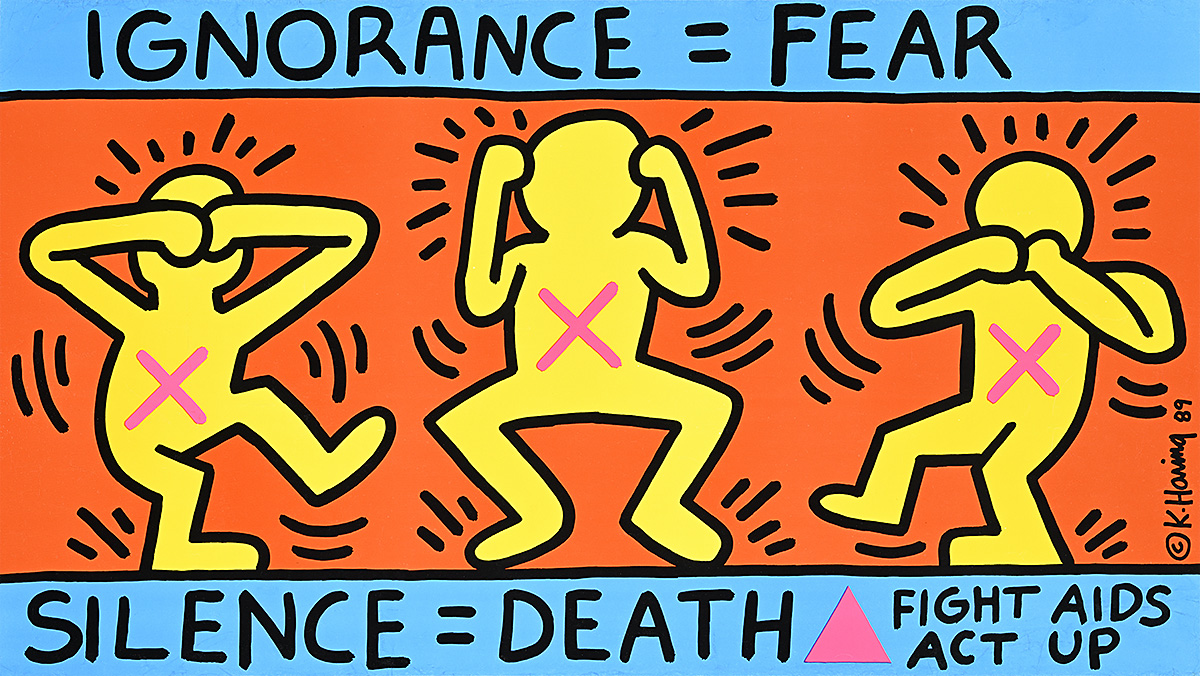
Ignorance = Fear/Silence = Death (1989) by Keith Haring
Poster House Permanent Collection
SK: Keith Haring transformed activism into pop culture. His bold figures made the message impossible to ignore. Ignorance = Fear/Silence = Death conveyed ACT UP’s urgency in a straightforward and direct way. He connected art, activism, and mainstream culture like few others could.
Love Ball II (1991) by Julian Schnabel
Poster House Permanent Collection
SK: I was working at DIFFA when Susanne Bartsch organized the Love Balls. Fashion, art, and nightlife combined in a way I’d never seen—it was the height of the Ball movement. The second event was even larger and more emotional. Schnabel’s poster captured that spirit—raw and defiant. Two versions were sold to raise additional funds; I still have one at home. The Love Balls showed that even celebration could serve as a form of resistance.
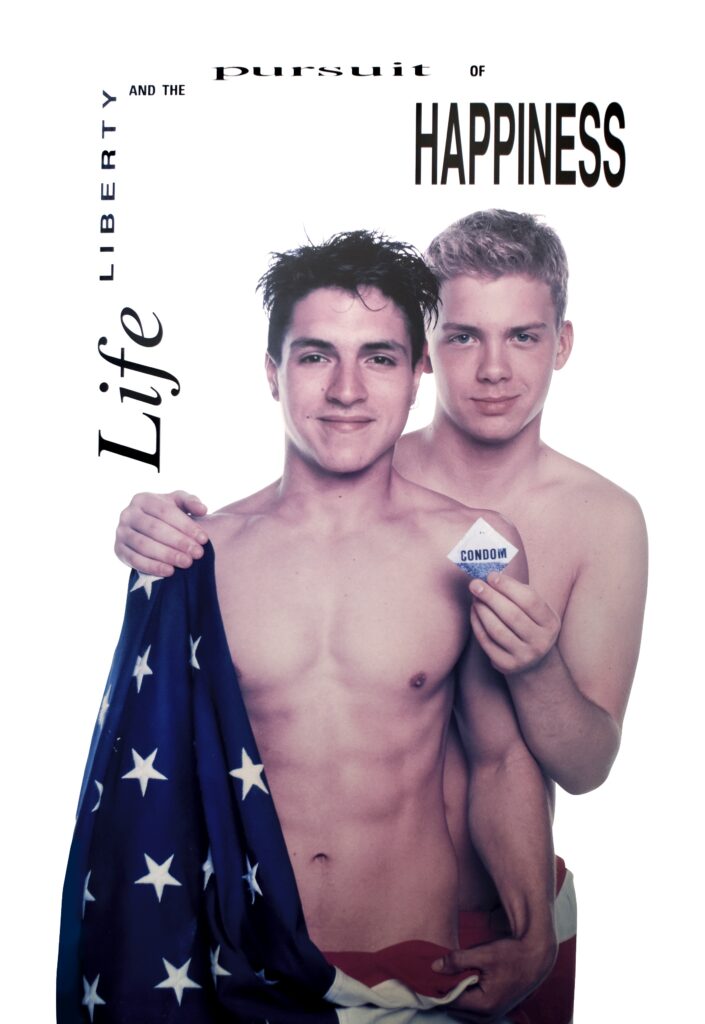
Safe Sex is Hot Sex (1991) by Steven Meisel
Poster House Permanent Collection
Safer Sex is Hot Sex (c. 1992) by Steven Klein
Poster House Permanent Collection
SK: By the early ’90s, fashion had become a key part of the AIDS fight. The Safer Sex campaigns brought together creative people for a common cause. My friend Anneliese Estrada at DIFFA organized the shoots and enlisted everyone—photographers, models, stylists—to volunteer. The first “Safe Sex” ads caused backlash; people argued that nothing was truly safe. The next version was “Safer Sex,’ shot by Steven Klein with a different tone. Anneliese’s girlfriend Lita modeled in it, making it personal. Groups like DIFFA and the Red Hot Initiative proved that design and pop culture could save lives.
Red Hot + Dance (1992) by Keith Haring
Poster House Permanent Collection
SK: I remember when this was released—it was everywhere you looked. The album combined activism with music: George Michael, Madonna, Seal. Leigh Blake made it happen through sheer determination. Haring’s artwork was lively but simple. Red Hot + Dance brought AIDS awareness into homes and onto dance floors. It showed that fighting back could also mean just showing up.
The Sleaze Ball (1992) by Jon McEwan
Collection of David Kennerley
SK: The Sleaze Ball was activism with attitude—fundraisers that didn’t look like typical charity events. It supported groups focusing on research, visibility, and safety. McEwan’s poster, bold and layered, reflected the downtown energy of that era. You’d see it in club windows or on the street—a reminder that even in crisis, the community remained visible.