Family Guide: Designed to Be Red: Native American & Indigenous Poster Works
This exhibition is rated PG-13. Parents and guardians should be aware that this exhibition includes:
- Racist caricatures of Native people and Native culture as well as posters featuring racist language.
- The discussion and visual representation of the violent colonization of Native lands and people by European settlers and Americans.
Guiding Language
See below for recommended language when describing key terms from this exhibition to young learners. This language was created with children ages eight and up in mind.
- Many of the posters and artworks in this exhibition refer to the history of colonization. Colonization happens when one country takes over another land and uses its resources, often without permission from the people who live there. Some historians and activists refer to this as land theft. The people living in colonized lands are often Indigenous, meaning that they are natives who have lived in that country or land for a very long period of time.
- A Nation is an independent community or group of Indigenous people who have their own government and cultural practices.
- Some of the posters in this exhibition question the ideas behind advertising campaigns created by American and European companies in the 19th and 20th centuries. These advertisements often stereotyped Native Americans. A stereotype is a fixed idea about what a certain group of people is like. This idea is often untrue and hurtful. Advertising like this that takes advantage of a particular group for commercial purposes is also referred to as extractive marketing.
Additional Resources
- For further guidance, sign up for the Poster Kids event(s) related to this exhibition. Poster House’s educators are trained to facilitate age-appropriate discussions around a diverse range of topics.
- Looking for hands-on activities? This exhibition is accompanied by an interactive, family-friendly handout. Visit the museum for the full experience!
Recommended Works and Guiding Questions
The graphic design and artwork in Designed to Be Red reimagines Indigenous history and culture for the present and future. While many people believe that Native American culture is part of the past, the posters and objects in this exhibition show that Indigenous life, art, and design continue to inspire Indigenous and non-Indigenous people alike.
Each of the objects below relates to the past, present, and future of Indigenous rights and community in a unique way.
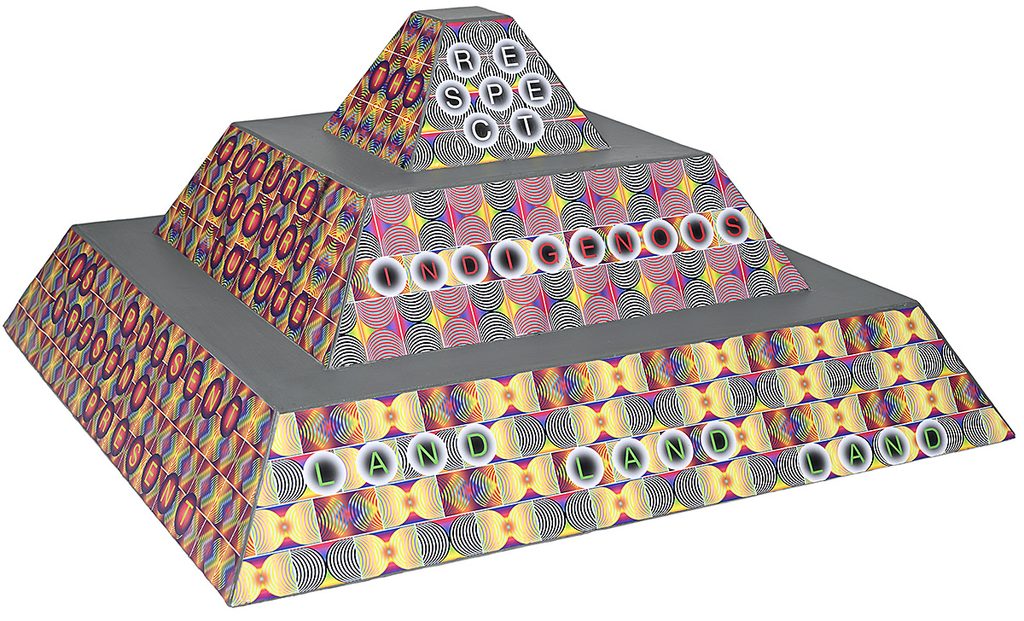
Because Once You Enter My House, It Becomes Our House, Jeffrey Gibson (Mississippi Choctaw/Cherokee), 2020
This is a model of a sculpture by Indigenous artist Jeffrey Gibson. The original work was 21 feet tall!
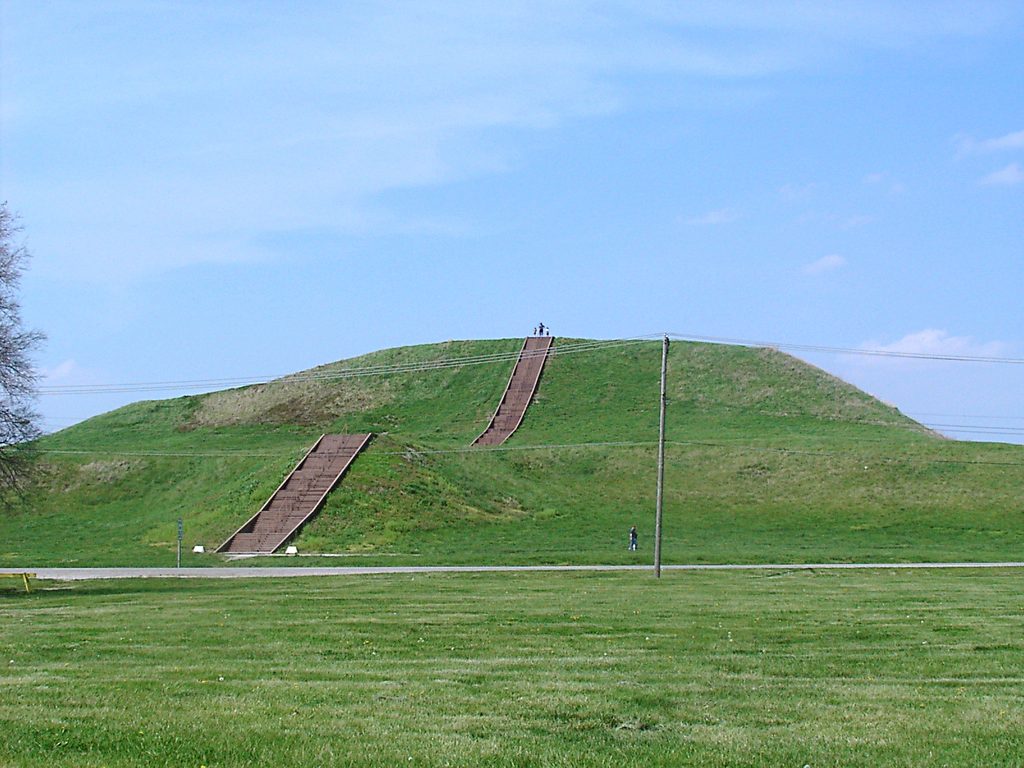
The structure references the architecture of Cahokia. A thousand years ago, Cahokia was an Indigenous city where tribes from all across America would meet to trade and exchange ideas.
Monks Mound of Cahokia, St. Louis, Missouri, Wikimedia/Skubasteve834, 2007
- How would you describe the patterns and colors you see on the sculpture?
- What words and phrases do you notice on the sides of the sculpture? How do these words make you feel? What do you think they communicate to the viewer?
By combining Cahokia’s architecture with vibrant colors and powerful messages, Gibson’s sculpture honors both the past and the present. The colors and words reflect the diversity and power of present-day Indigenous community while the structure references Indigenous communities of the past.
- There’s another reference in this artwork: Its title is named after a song by musician Mr. Fingers called “Can You Feel It.”
- Listen to the song and reflect on the title of the artwork. What do you think it means? How do you think the music’s rhythm and song is represented by the colors, patterns, and emotions of Gibson’s sculpture?
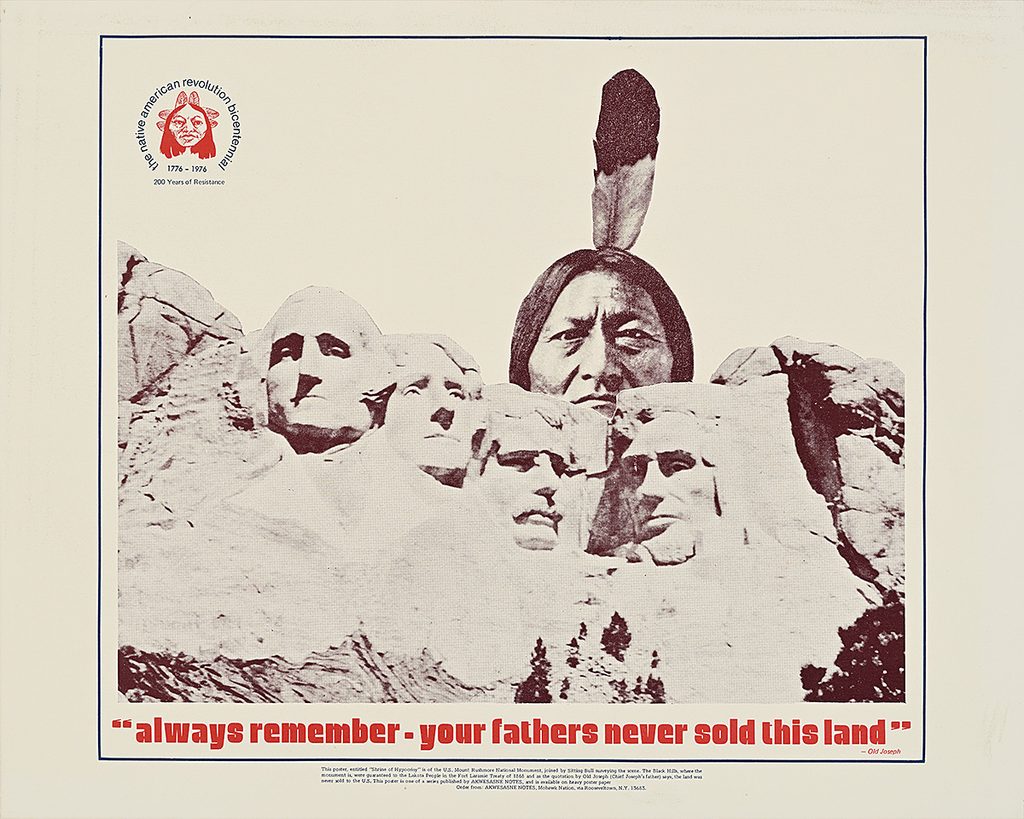
Shrine of Hypocrisy, Akwesasne Notes (Mohawk Nation), 1975
The poster shows Sitting Bull behind the American presidents at Mt. Rushmore. Do you recognize any of the presidents carved into the stone?
The presidents honored at Mt. Rushmore created or contributed to government policies, some of which forced Native people out of their lands. During the 1960s and ’70s, there was a growing movement and call for Native American rights and land reclamation. Land reclamation refers to the idea that Native American land should be returned to Indigenous ownership, and that Indigenous people should have the right to control their own resources, education, and government on those lands.
Shrine of Hypocrisy is a poster that was distributed by Akwesasne Notes, a Native American newspaper created in 1969 to support the movement for Indigenous rights and land reclamation.
- Reflect on the title of the poster. What does shrine mean? And what does hypocrisy mean? What do you think is meant here by a shrine of hypocrisy?
- Mt. Rushmore is a monument to some of the most important American presidents. Think about the way that American presidents and history are typically discussed. Then consider the poster’s message. Why did the designer choose to add a photograph of Sitting Bull to the image of Mt. Rushmore? What might the designer want us to question about American history?
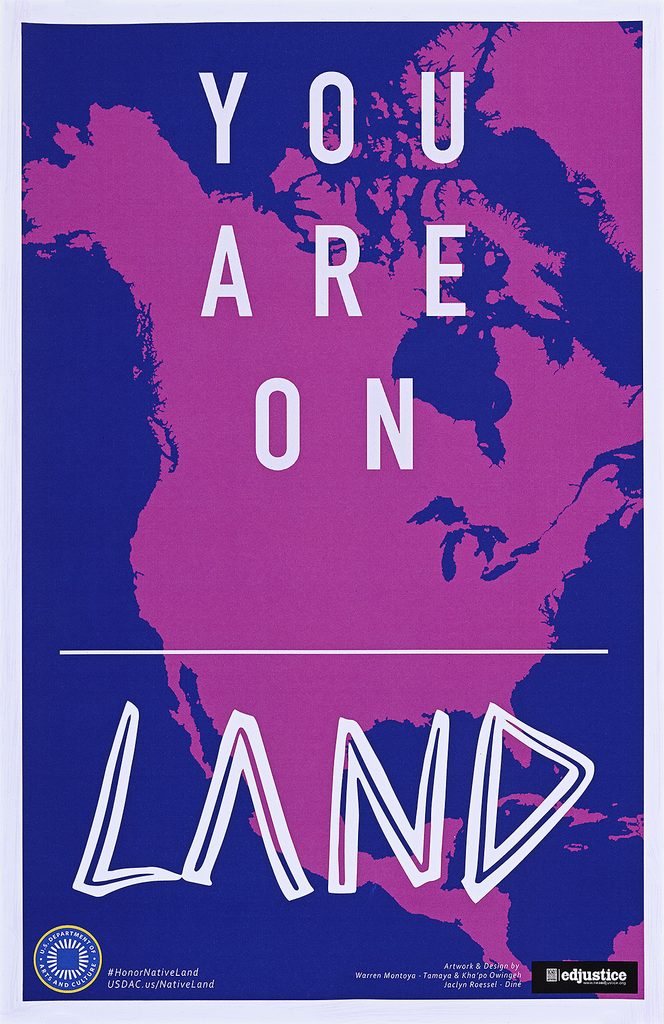
You Are On _____ Land, Warren Montoya (Tamaya/Kha’po Owingeh) and Jaclyn Roessel (Diné/Navajo), 2017
The movement for Indigenous rights has been ongoing since the mid-20th century. Activists have changed their approach to poster design over time, gradually highlighting new issues like land acknowledgment. Land acknowledgment means recognizing the Indigenous tribes that originally inhabited a particular piece of land as its caretakers.
This poster by Warren Montoya and Jaclyn Roessel was designed to be distributed to schools and community centers. Rather than creating a poster that was only intended to be looked at, they ask viewers to fill in the blank space above the line.
- Can you fill in the blank? Use this map to locate the name of the tribes that are indigenous to your neighborhood. You can learn more about the Nations or tribes using the resources on the same website.
- Think about other places besides community centers or schools where this poster could be distributed. If you could reprint this poster, where would you distribute it, and why?
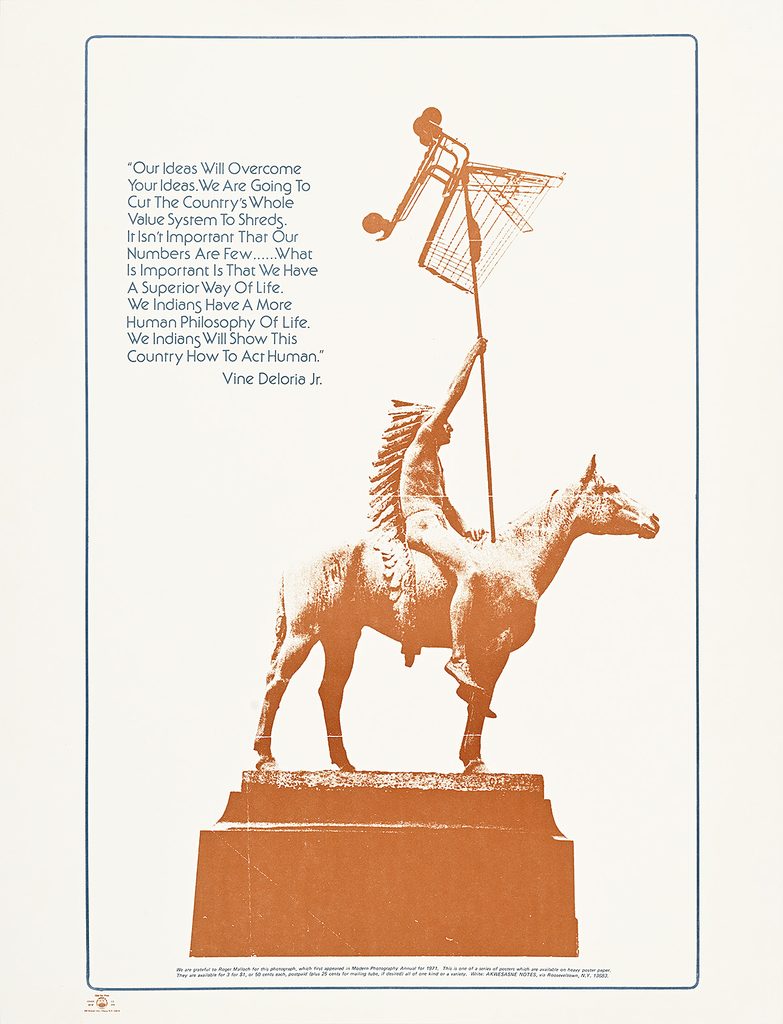
Our Ideas Will Overcome Your Ideas, Akwesasne Notes (Mohawk Nation), 1980
Another poster created by Akwesasne Notes, Our Ideas Will Overcome Your Ideas, features a quote from Sioux author Vine Deloria, Jr. and an image of a famous Chicago statue.
- Read the quote on the poster. Review the words you don’t know with your parent or guardian. Which words or phrases stand out to you and why? What do you think is the main idea or message of the quote?
A Signal of Peace, Cyrus Edwin Dallin, Lincoln Park, Chicago, 1890 (image: Wikimedia/Alanscottwalker, 2011)
The quote sets the tone for the central image of the poster, a photograph of the 1890 bronze sculpture A Signal of Peace by Cyrus Edwin Dallin. This sculpture is located in Lincoln Park, Chicago. Although Dallin created the sculpture to honor Indigenous culture, many critics argue that it stereotypes Native Americans as naive or primitive.
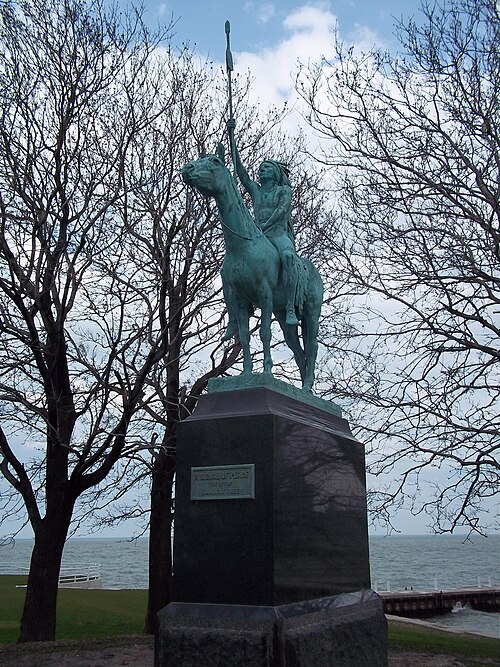
There is a difference between the actual sculpture seen in the photograph above and the one in the poster. Do you see what it is?
In 1971, the sculpture was vandalized by Michael Mulloch, who placed a shopping cart on top of the Native warrior’s staff.
- Think about how shopping carts are used in daily life. What does a shopping cart represent?
- How might adding a shopping cart to the sculpture change the sculpture’s meaning?
- Finally, reflect on the connection between the quote and the photograph of the sculpture in the poster. How does the image enhance the message of the quote?
Creativity starts with curiosity.
Select the newsletters you'd like to receive from Poster House.
JOIN EDUCATION NEWSLETTER