



Detroit Design Week: Posters and Black History
The Scarab Club was founded in Detroit, Michigan, in 1907 (initially as the Hopkin Club after maritime painter Robert Hopkin) as an arts club for artists and enthusiasts alike. Its name from 1909 reflected the Western interest in such ancient Egyptian objects as scarabs—sacred dung beetles that represent life and regeneration—an aspect of the Egyptomania that had gripped artists and designers since the early 19th century. The club’s mission was always to educate the community, hosting lectures, exhibitions, parties, and talks on artistic and cultural themes. Thus, in September 2025, I was invited to speak at the club about all things posters during Detroit Design Week; I also used the opportunity to introduce my exhibition at Poster House—Act Black: Posters from Black American Stage & Screen.
During my visit to Detroit, it became especially clear to me why Black history is American history and the range of perspectives that contribute to that history. I went to the Charles H. Wright Museum of African American History (known as “The Wright”) to view The Tuskegee Airmen: Two Victories!, an exhibition that chronicles how the Tuskegee Airmen fought two battles during World War II, one against the Axis powers and the other against racism on the homefront. The museum further contextualized the known history of the Tuskegee Airmen’s efforts to defend the country and themselves at a time when it was by no means clear that one victory would lead to the other. But this history had even more resonance for me; partly because of my research on the Act Black exhibition, I am well aware that aviation has been a symbol of Black aspiration and travel since the invention of the first aircraft in 1903.
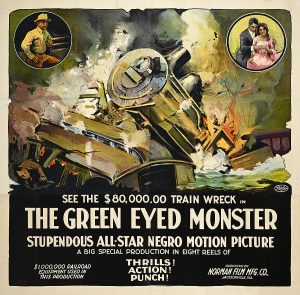
I wrote a blog titled Silent in Jacksonville: Norman Studios’s Race Films where I discussed my research trip to Norman Studios in Jacksonville, Florida. While there I viewed a variety of original race film posters, including one for The Flying Ace (1926). The only race film by Richard Norman that exists in its entirety today, The Flying Ace tells the story of a World War I fighter pilot who returns home to his job as a railroad detective and must recover stolen company cash from local thieves. Norman’s centering of the film around flight offered a powerful message to audiences, especially at a time when Black Americans were barred from attending aviation school in the United States. The poster, depicting the pilot and his plane, honors what at the time was an idealized future in which Black people could become heroes despite ongoing systemic racism. Together, the exhibition on display at The Wright and The Flying Ace poster present a rich, expansive view of Black aviation in both history and design.
The Flying Ace, 1926
Collection of Allen Airways Flying Museum
In preparation for Act Black: Poster from Black American Stage & Screen, I searched high and low for the rare posters that truly capture the celebration and beauty of all-Black theater and film productions from the early 20th century. The invitation to speak at the Scarab Club came at such a perfect time; I had spent the past year collaborating with Detroit-based The Black Canon, an arts organization that describes itself as “dedicated to preserving and promoting African American literary, performing, visual and media arts.” It is also home to one of the largest Black film and memorabilia collections in the world, and its holdings of posters, prints, and ephemera have been invaluable to my research. This collection is truly incredible, highlighting the passion and dedication necessary to the sourcing, documenting, and storing of some of the rarest pieces, all representing a glorious era of Black industry, innovation, and artistry.
Temptation, 1935
The Black Canon Collection
At the Scarab Club, I spoke to an intimate audience about the importance of both the partnership and the posters themselves. The exhibition will address a broader history that honors Black American identity in the United States. Detroit is home to the Second Baptist Church (a stop along the underground railroad), the Motown Museum (that explores the renowned label and sound), and the Alger Theater (which hosted Duke Ellington, the celebrated jazz musician who featured in some of the race films explored in the Poster House exhibition). It was a delightful experience to learn about Detroit and, in turn, to discuss posters as time capsules with the audience, experiences that will surely be reflected in Act Black and its corresponding programs. I’m grateful to both the Scarab Club and The Black Canon for this opportunity!
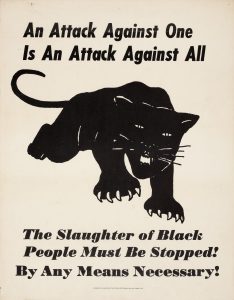
Es‑pranza Humphrey is the Assistant Curator of Collections at Poster House, where her research centers on Black performance, fashion, and visual culture. Her scholarship on the graphic language of the Black Panther Party has been featured in The New Yorker, NPR, and ABC’s Here and Now, as well as several international publications. Her current exhibition Act Black: Posters from Black American Stage and Screen explores Black American theater and film posters from the 1870s to the 1940s.