

Any curator can tell you how many small miracles must occur to get an exhibition from concept to wall, and shows that feature a “rediscovered” artist have their own special challenges. The museum takes more risk because there isn’t a built-in audience, the curator needs more time to ferret out the artist’s story, and the odds increase that key works will simply have disappeared. And then there are the stakes: without a successful exhibition, yet another worthy artist is likely to be forgotten. On top of all that, even a successful show will itself beg the question: how is it that such a talented artist, recognized in her time, fell into obscurity? Such matters tend to be beyond the scope of the exhibition but Poster House (bless it!) has invited a blog post on this very subject.
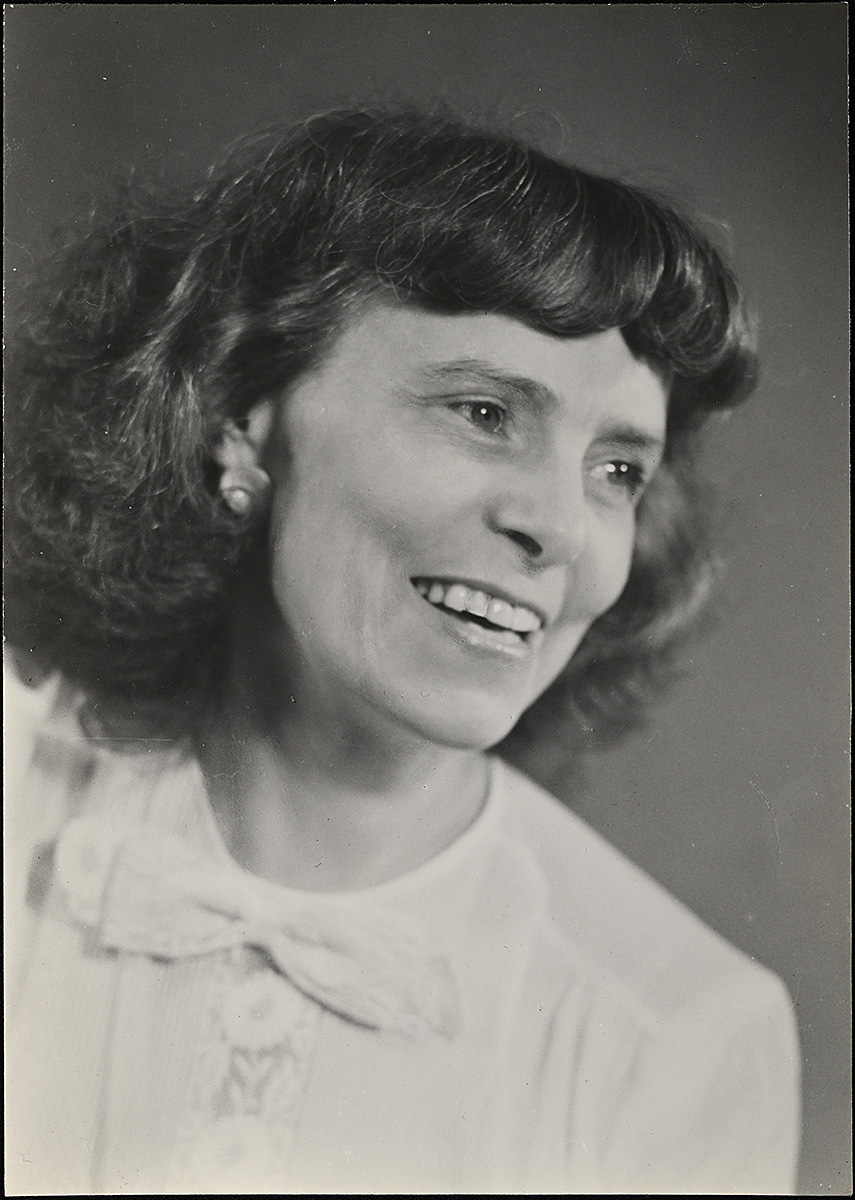
Dorothy Waugh, c.1930
The backstory of my exhibition on Dorothy Waugh, whose work for the federal government during the Great Depression put her in the vanguard of American graphic design, certainly has its share of improbabilities.
In the 1990s, two of Waugh’s national parks posters caught my eye as I passed the window of a prominent gallery in New York City. Although I was already fairly deep into graphic design history, I knew nothing of Waugh or her work. So I had to just look at the posters without any other point of reference. It was the best kind of introduction, and what I saw was terrific—brilliantly executed compositions that were at once accessible yet leaned toward the avant-garde.
Not only were these the first Waugh posters I encountered, but I have not seen them on the market since.
I wanted to know more. With work that was this good, and especially because the posters were created for a highly visible government campaign, I was certain that I could quickly learn a lot. I was soon disappointed when my research revealed almost nothing or, worse, turned up information that seemed just plain wrong. Nor did I have much time to dig deeper. I had a consuming job as an executive in the film industry, my wife and I were raising our young sons, and on the side I was curating a large exhibition titled The American Image: U.S. Posters from the 19th to the 21st Century and writing the accompanying book.
During the 2010s, however, I was able to tack on a day or two to business and family trips, visiting the many places where I might piece together Waugh’s story through primary documents. Armed with my phone’s camera, I took countless photos of what I found, intending to review them whenever I might later have the chance. I visited the National Archives; the Waugh Family Papers in the Jones Library in Amherst, Massachusetts; the School of the Art Institute of Chicago; and the Library of Congress.
Photos from two of the many sites I visited on my quest: at left, the National Archives in College Park, MD; at right, the Jones Library in Amherst, MA.
I also consulted with anyone who might have a good lead. And in a parallel nationwide hunt, I managed to find all of Waugh’s surviving posters and key related artifacts—the “needles in a haystack” essential for an exhibition—and confirm that their owners would loan them.
Beyond improbability, it emerged after years of searching that the last poster required to complete the exhibition, National Parks/Skiing, was owned by a good friend. She graciously loaned it to Poster House.
Everything was finally starting to come together and the perfect museum for the exhibition, Poster House in New York City, had expressed interest. But the onset of the Covid-19 pandemic and my new role as the acting director of the Memphis Brooks Museum of Art in Tennessee again pushed the exhibition to the side. Finally, during 2024–2025, and after an untold number of hours of writing, the exhibition and its related book coalesced. A mere three decades after I first saw that pair of striking posters in a gallery window.
If getting rediscovered was hard, Waugh’s slide into obscurity was all too easy.
When she died in 1996, just shy of 100 years of age, there was no obituary and little notice has been taken of her since. This despite the fact that Waugh received considerable recognition, and sometimes acclaim, during her lifetime.
We can readily speculate on the reasons. Waugh was a woman. (Studies have shown that news outlets are considerably more likely to select similarly accomplished men than women for obituaries.) Unmarried and without children, she had no surviving immediate family to attend to her legacy. She did her most public work for the National Park Service (NPS) early in her career. And her artistic practice emphasized design, illustration, craft, and accessible writing, none of which were bound to be critical darlings.
But I’d add something else: Waugh was a polymath and her pursuit of a multitude of career paths in rapid succession likely—and ironically—contributed to her lack of renown today. In addition to her work as a landscape architect and graphic designer for the NPS:
As this long list shows, Waugh chose to go as broad in her pursuits as she went deep, and to keep moving (never, for example, returning to poster design). That choice was unlikely to bring her the kind of renown typically associated with commitment to a single field. But it reflected her many abilities, boundless curiosity, and a pragmatic need to pay the bills. It reflected who she was.