


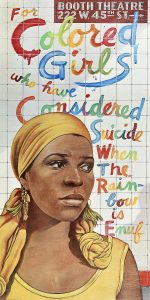
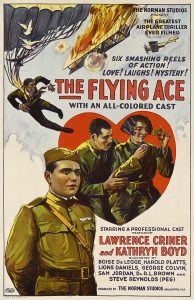


Act Black: Posters from Black American Stage & Screen is a smash hit and also Associate Curator of Collections Es-pranza Humphrey’s first exhibition in our biggest gallery. She sat down with Chief Curator Angelina Lippert for a discussion about this landmark show and the working process behind it.
Angelina: Many people don’t realize how long it takes to build an exhibition at a museum. Can you talk about how you got the idea for this show and how you fleshed out the concept that was ultimately pitched to me?
Es-pranza:
My research focus for about a decade has been on the fashion of Black chorus girls during the interwar period and how they represented the “New Negro Woman.” I’d always planned on expanding that research in the future, knowing that there was more information and materials that could anchor the topic. The opportunity came when I started to search for posters related to Black theatrical productions (specifically those featuring Josephine Baker) and came across posters and window cards for some of the most notable all-Black musicals—like Porgy and Bess. I then came across a collection of film posters that reinterpreted or directly retold the stories that had once premiered on the stage.
I realized that the best way to present the history of Black theater was to continue through the 20th century and look at the history of Black film. Early films often mimicked theater because the technology was still novel. A show that was produced for both theater and film was also a great way to add more dynamic posters to the exhibition because not many exist for official theatrical releases at that time but there were some great posters that survived from the race film era.
Connie’s Hot Chocolates (1936), by Designer Unknown
Poster House Permanent Collection
Angelina: What were some of the posters you absolutely had to have in this show?
Es-pranza:
My meeting with the Harlem historian John T. Reddick meant that I was able to connect with Hugh Hill, who had what I believe is one of the rarest posters in the exhibition: Two Reel Coons featuring Bert Williams and George Walker. Their images are largely represented on sheet music and in photographs but at that time, most posters for stage performances used stock images or generic language. This one is quite detailed and gives us the names of the top Black performers of the day.
I absolutely had to include this one in the show because it really is a showstopper that guides the theater section in a thoughtful way. I’ve never even seen a poster of this size with Williams and Walker in a photograph. I think that Poster House visitors will find this piece to be something unique and special while also learning about the complicated history of blackface minstrelsy.
Angelina: Were there any disappointments along the way? How did you handle these pitfalls and what new narratives emerged?
Es-pranza:
Posters for tent shows or vaudeville performances are very rare because they were typically wheatpasted or posted for a finite amount of time while the show was in town. Theatrical productions in the late 19th and early 20th centuries didn’t solely rely on posters for advertising, so in some cases there just aren’t many prominent posters that exist. This reality was a disappointment because Poster House is for posters!
I had to navigate this by thinking about the formal definition and purpose of visual culture. The poster might not exist but all posters go through a production process at a print shop that might have survived. After you and I spoke, we realized that it was just as important and interesting to show the wooden printing blocks from Hatch Show Print as the final products on paper because the blocks have survived for almost a century. This solution adds texture to the overall exhibition and allows visitors to lift the veil on the process of poster production in a way that we have not yet done!
Silas Green from New Orleans (c. 1945), by Designer Unknown
Hatch Show Print
Angelina: Were there any curatorial challenges that happened as you got more familiar with the content and history of these posters?
Es-pranza:
Navigating language, especially during a time when certain words or phrases were part of the vernacular, is often challenging. There was such a liberal use of certain words or terms that we would surely find unacceptable and offensive today but at the time were seen as appropriate or, at the very least, normal—even if they were fundamentally derogatory. I had to decide how to explain language and I had to unpack the historical context because part of appreciating Black theater and film is understanding that there were some shared cultural experiences, and that certain colloquialisms were (and still are) a way to articulate them. Language is also a lens into the normalized racism and anti-Blackness that established the need for all-Black productions in the first place.
Angelina: Were there any surprises you found in your research?
Es-pranza:
There’s a landmark documentary called In the Shadow of Hollywood: Race Movies and the Birth of Black Cinema. It chronicles the history of the race film genre, segregated theaters, filmmakers, and Black actors who contributed to and transformed the film industry in the United States. There’s a portion of the documentary where an individual speaks about how cases of race films were uncovered in an abandoned building. I won’t spoil the documentary because I do think everyone should watch it but this part fascinated and surprised me during the research process. Essentially, we would not have some of the film reels that we can watch today if they hadn’t been uncovered and “randomly” stored away. Many would be considered lost films with only the posters around to tell the story. Luckily, for a number of films in the exhibition, we have both—as they did in the early 20th century.
Photos from Norman Film Studios (2025)
Angelina: If there’s one thing a viewer walks away with after experiencing this exhibition, what would you want it to be?
Es-pranza:
Viewers should see this exhibition as a celebration of theater and film! The posters and ephemera are a glimpse into historical events like the Civil War and Reconstruction-era agencies like the Freedmen’s Bureau. The posters also celebrate communities that were meccas for Black culture like Harlem and Chicago, and spotlight Black women as aspirational figures with careers at a time when women in general could not often exercise agency in male-dominated fields. Act Black: Posters from Black American Stage & Screen blends history, culture, and language to remind visitors of the importance of a time when Black actors, on the stage and on the screen, created a realm of opportunity within the most popular forms of American entertainment.
Chicago After Dark (1946), by Designer Unknown
Poster House Permanent Collection
Es‑pranza Humphrey is the Assistant Curator of Collections at Poster House, where her research centers on Black performance, fashion, and visual culture. Her scholarship on the graphic language of the Black Panther Party has been featured in The New Yorker, NPR, and ABC’s Here and Now, as well as several international publications. Her current exhibition Act Black: Posters from Black American Stage and Screen explores Black American theater and film posters from the 1870s to the 1940s.
Angelina Lippert is the Executive Director and Curator of Poster House in New York City, the first museum in the United States dedicated to the art and history of the poster. She is the author of The Art Deco Poster, co-author of Wonder City of the World: New York City Travel Posters and Art for Art House: The Posters of Peter Strausfeld, and has contributed essays to Poster Cult on the letterpress designer Dafi Kühne, Steve Heller’s The Education of a Design Writer, and 150 Stories by the Art Students League. She was a recipient of the Emily Hall Tremaine Journalism Fellowship for Curators through Hyperallergic, and has written about design for The Muse by the Clio Awards. She is a former critic on art, design, and fashion for the New York Journal of Books.